
The Disappearing Middle – What Happens When We Automate the Work That Taught People How to Think
The Disappearing Middle – What Happens When We Automate the Work That Taught People How to Think
The Disappearing Middle
What Happens When We Automate the Work That Taught People How to Think
Issue 284, October 1, 2026
Most of the talk about AI and jobs is about numbers. How many jobs go away, in which fields, and how fast. Those are fair questions, but they are questions about the immediate and near future. The one I keep pondering doesn’t seem to be getting much attention. What happens five years from now, ten years from now, when the people we count on to know things were never given the chance to learn them?
The experienced person sitting across from you in a meeting likely didn’t show up to work with fifteen years of judgment already in place. They earned it doing the research nobody else wanted to do, writing first drafts that got marked up, sitting in the back of a meeting, learning, by watching senior leaders conduct discussions about substantive topics. A lot of the judgment built over time came from doing work that, by today’s standards, looks routine. And this type of work is exactly what we seem to be automating first.
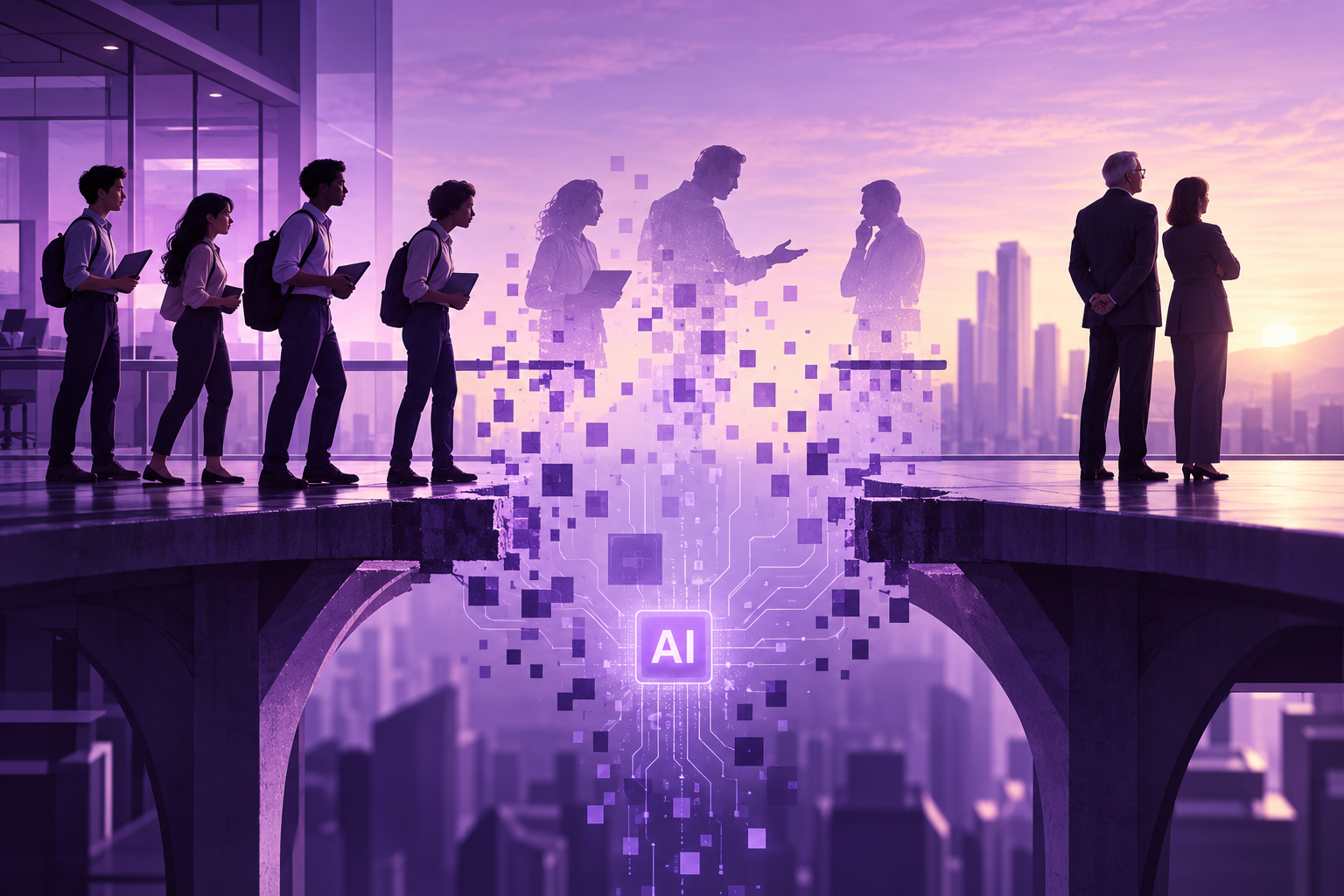
That, to me, is the problem that we aren’t seeing in organizations today. We are changing how the work gets done without changing how people learn to do it nor addressing how they develop the critical thinking skills that they need. And it seems to be happening in two places at once. At the start of a career, where the early years that used to build judgment are getting cut or radically changed. And in the middle of the organization, where the managers who used to pass that judgment along are being flattened out or let go. Two types of middles, both changing or disappearing, and the cost of both is likely to show up later. We are often focused in the immediate and fail to see the unintended consequences of our actions and decisions. This is surely the case in the present moment.
The Work Beneath the Work
If you have ever brought on an intern or trained a new hire, you know how this goes. The repetitive work goes to them. Pulling the data together. Updating the spreadsheet. Drafting the first version of the memo or the report or the member, customer or shareholder communication. Sitting in on the meeting and taking the notes. Checking the numbers somebody else produced. It doesn’t matter whether it is a marketing department, a finance office, a hospital, an association, or a law firm. That is how the first year or two has always worked, for us and for everyone who came before us. Some of it is boring. Some of it is repetitive. And a lot of it can now be done, at least as a first draft, by an AI tool in a few minutes.
From a productivity point of view, the case is obvious, everyone is seeking to save time. Why have a new person spend an afternoon putting a summary together when the tool can do it in a few minutes? And likely faster than the time it would take you to communicate what you want someone to do?
Why have someone compare two documents by hand, or write up meeting notes, or take the first crack at a draft, when the models do it faster? There isn’t anything special about menial, repetitive work which is why we always viewed our own efforts as induction activities and expected everyone coming after to do the same. Today, it just seems easy with a prompt or a couple of sentences to get the work quickly out of the way. But we have to ask what was that work really doing?
It was doing two things at once. The new hire pulling the data together was also learning where the numbers come from, which ones to trust, and where they don’t add up. The one drafting the report was learning how to make a case, how to justify their thinking and analysis, and what happens when someone with twenty more years of experience pokes holes in it. The one in the back of the meeting taking notes was watching how a seasoned person deals with pushback, office politics, and not having all the facts. None of that was in the job description but all of it was at its core, the point.
Those experiences produced professionals who, over time, would rise up in the ranks, know the work, and know how it gets accomplished. When an organization takes the work away because the tool can produce the deliverable faster, the productivity gain remains very real and tangible. But the learning that came along with the task doesn’t show up anywhere in the young staff. There is then a growing gap that we aren’t addressing.
What the Numbers Say So Far
The research on this is still early, but there is enough of it available to see a pattern.
In August, Erik Brynjolfsson, Bharat Chandar and Ruyu Chen at the Stanford Digital Economy Lab updated their study of what AI is doing to employment, using payroll records from ADP that cover millions of American workers. They don’t see widespread job losses across the economy tied to AI, which is worth keeping in mind the next time a headline says otherwise. What they do see is concentrated among the youngest workers. Among people aged 22 to 25 in the jobs most exposed to AI, employment now sits about 19 percent below where it would be if it had kept pace with people the same age in less exposed jobs. Experienced workers show no comparable gap. And the way it’s happening is not through layoffs. It is through fewer young people being hired in the first place. Nobody is being pushed out the door. The door is just not opening.
So the research is not saying AI has wiped out a fifth of entry-level jobs yet. It’s saying that in the fields most exposed to the technology, the youngest workers have fallen well behind their peers, and that the reason is fewer first jobs. If organizations stop hiring into the roles where careers used to start, then where the next generation of experienced people will come from isn’t going to follow what we considered to be the path.
A second study, by Samuel Westby, Alicia Sasser Modestino and Peiran Cheng, published in June through IZA, looked at 5.7 million U.S. job postings for software developers from 2019 through early 2025. After ChatGPT came out, postings for junior developers dropped 14 to 15 percent compared to postings for senior ones. At the same time, employers started asking for more experience within the same job titles, about a third of a year more, and the junior postings that were left put more weight on problem-solving, communication, and attention to detail. So there are fewer doors, and the doors that are left ask for more experience to get through them; at the same moment, the usual way of getting that experience is being automated. Those changes look unrelated, but they aren’t.
And late last month the Federal Reserve Bank of Dallas added a third piece. Samuel Dodini and Tucker Smith followed graduates of Texas public universities from before and after late 2022. Graduates from majors more exposed to AI saw a relative drop in employment, and among those who did find work, first-year earnings fell about five percent compared to graduates from less exposed majors. Texas is one state, but if you have a son or daughter, a niece or nephew, or a neighbor’s kid who graduated in the last two or three years, you have probably heard a version of this already, and it didn’t come from a study.
The Other Middle
Most of us have lived through at least one downsizing, and if you have, you know who goes first when an organization decides it has too many layers. It isn’t the people doing the work and it isn’t the people at the top. It is the managers in between. I have written before about middle management’s impossible position, and Season 2 of The Human Factor Podcast spent a full episode on the middle management trap. Middle managers are the translators. They take what leadership wants, square it with what the organization can actually do, and help the people doing the work understand why it matters. They also carry the knowledge that never makes it into a manual, like why a process exists, which relationships matter, how decisions really get made, and where the organization is weak. Tina Berger and I covered this in depth in last week’s episode, the gap between the work as it is written down and the work as it actually gets done.
Middle managers also do something that almost never shows up in their goals, which is helping a less experienced person build skills and judgment. Think about the manager who taught you the most, perhaps even became a mentor. Odds are it wasn’t in a training session. It was the one who noticed you were in over your head, who explained why the recommendations you were so proud of were going to land badly, who walked you through what a hard decision was going to cost before you made it. That manager wasn’t passing information down the chain. That manager was building you, one piece of advice and one conversation at a time.
AI now makes that role harder in a way the usual reorganization never did. As organizations look for fewer layers, faster decisions, and less coordination, everything that looks like management work is being examined for what can be automated. Some of that is fair. No manager should spend the week putting together status reports, reconciling spreadsheets, or relaying information that could have gone straight to the person who needed it. Take that away and you have done them a favor. But when the administrative work goes, what happens to the time that gets freed up? Does it turn into time for coaching, for watching how people work, for passing along what the manager knows? Or does the organization just give that manager more people, more projects, and more initiatives to look after, on the theory that the tool made room? That seems to be what is happening, either because people feel they can take on more or because they fear more will be assigned now that the tools have made everyone more efficient.
I have yet to see an organization answer that question on purpose. It gets answered by default, and the default is more tonnage, to borrow David Edward’s phrase from last week. Anyone who has survived a round of cuts knows what it feels like to inherit two other people’s teams and be told the new system will make it manageable.
Information Is Not Expertise
One of the most common mistakes in the AI conversation is treating access to information as if it were the same thing as expertise. An experienced doctor doesn’t just know more facts than a resident. An experienced engineer doesn’t just have more formulas. A seasoned membership director doesn’t just have more data on the members. What they have is the ability to tell when the information in front of them is incomplete, when a familiar pattern doesn’t apply, when the obvious fix is going to cause a bigger problem somewhere else, and when the cost of being wrong calls for more care. That was learned by doing the work and by being told, sometimes bluntly, that the last attempt was wrong.
A 2025 study from Microsoft Research and Carnegie Mellon, presented at the CHI conference, surveyed 319 knowledge workers and collected 936 real examples of how they used AI at work. The more confidence people had in the AI, the less critical thinking they reported doing. The more confidence they had in themselves, the more critical thinking they did. Across the examples, the thinking itself changed, away from doing the work and toward checking, combining, and overseeing what the system produced. I wrote about this in The Confidence Transfer in July, from the point of view of experienced people handing their judgment to the machine. Here it is the same problem from two other points in a career.
Checking and overseeing are reasonable work for an experienced professional. It’s a different thing to ask that of someone who has never done the underlying task and has nothing to check it against. More and more, we are asking people to supervise work they never learned to do, and treating the ability to recognize an answer that sounds right as if it were the ability to know whether it is right.
None of this means the young professional who is good with AI is a lesser professional. A 2025 Microsoft study, published in Management Science, ran field experiments with 4,867 software developers at Microsoft, Accenture, and a Fortune 100 company. Developers who had an AI coding assistant completed about 26 percent more tasks, and the less experienced developers picked up the tool faster and gained the most from it. A separate Microsoft study of 125 interns in the summer of 2024 found that the ones who used Copilot more felt more connected to their teams, used it to get unstuck and to figure out the company’s internal jargon, and overwhelmingly said it helped them get things done faster. Anthropic’s June Economic Index, which surveyed about 9,700 of its own users, found that 68 percent said they were learning more with AI and 57 percent felt it had made their skills more valuable. The same report adds that these are self-assessments, and that skills can erode even while someone reports learning more.
So the technology can speed up learning and it can also hollow it out, often in the same office, and the difference is not whether AI was used. Picture two new hires on the same team. One uses the tool to chase down competing explanations, question the assumptions, and take apart an idea until she understands it. The other takes the polished output, drops it into the report, and moves on. On every productivity measure the organization uses, the two of them look identical, and they are headed in completely different directions. What separates them is how the work was set up, what each was expected to understand, and whether anyone with experience ever looked at what they produced and asked why.
Twenty years of experience doesn’t automatically produce judgment either. A person can do the same thing wrong for twenty years and get very good at doing it wrong (we have all worked with that person and our eye rolls in meetings and conversations were hard to conceal). What produces judgment is the quality of the experience, living with the consequences, and being willing to change your mind. AI doesn’t remove the need for any of that. What it removes is the way those things used to happen on their own, which means somebody now has to make them happen on purpose, and in most organizations the system isn’t yet structured to those ends.
The Bill Arrives Later
Organizations understand succession planning. They identify the critical roles, figure out who could step in, and worry about what happens if a key person leaves. But every version of it I have seen starts with people who are already there. It assumes the organization has already developed enough people with enough experience, and the right span of responsibility by title or job description, to be considered.
Now picture an organization that spends several years cutting back its junior ranks because the tool does most of what those people used to do, and thinning its management ranks because the tool made the coordination easier. The experienced staff stay productive. The technology investment pays off on schedule. Costs come down. For a while, it looks like a well-run business. Then the experienced people start to retire, move on, or simply wear out, and the bench the organization assumed was there turns out to be really thin. The gap didn’t open when they left. It opened years earlier, when the organization changed how the work was done and never changed how expertise was built. And because a smaller group of experienced people can now produce more with the tools, the shortfall looks like strength right up until it isn’t.
Some entry-level jobs never taught anyone anything, and some management layers were pure bureaucracy. AI is a chance to fix that of course. But fixing it means separating the work being automated from the skills that work used to build, and treating the second one as something you plan for rather than something you hope for. Use the tool to speed up the research, then ask the new person to explain why they trust those sources and where they disagree. Let it draft the recommendation, then put the up-and-coming employee in the meeting where the recommendation gets challenged. Take the reporting out of a manager’s week, then protect the hours that come back for the coaching that was never on the dashboard. None of that is about keeping people busy. It is about deciding that growing your people is something the organization is still responsible for and has to ensure remains into the future.
Where the Judgment Used to Come From
So take a look at your own organization and ask a few questions.
Who did the first pass on the last significant piece of analysis, and did anyone with experience sit down with the person who reviewed it?
When the tool freed up a manager’s time this year, where did that time go?
Look at the people in their first three years. Are they getting work that could go wrong in ways they would learn from, or only work the tool has already made safe?
And think about the person you would least like to lose. Who, specifically, is on the path to knowing what that person knows, and what are they doing this month that will get them there?
The people you count on today were once inexperienced people who were allowed to try hard things, get things wrong, and live with the results long enough to learn from them. Most of us can name the manager who let us do that and we remember those people fondly.
If we take those opportunities away without replacing them, we will end up with organizations that are very good at producing work and steadily less able to understand it. And by the time that shows up anywhere anyone is measuring, the middle we needed will already be gone.
Related Reading
The Confidence Transfer (Issue 271). What happens to organizational expertise when trust moves from the person to the machine. This issue is the same erosion, seen from the start of a career instead of the middle of one.
Receptacle or Receptor? (Issue 283). Last week, on the tonnage mentality and what organizations turn their people into. A manager handed more to oversee when the tool frees up her time is tonnage by another name.
The Identity Renegotiation (Issue 276). What AI asks people to give up before it gives anything back. The anxiety of someone entering the workforce today is not resistance to technology. It is a reasonable response to an uncertain path.
Coaching Across Generations (Issue 230). On coaching a five-generation workforce and why the youngest expect mentorship from day one. They are asking for exactly the thing the disappearing middle takes away.
Middle Management’s Impossible Position. From the Change Leadership Series, on the load carried by the people who turn strategy into work.
On The Human Factor Podcast
The Middle Management Trap, Season 2 Episode 016. Why the organization’s most critical change agents are set up to fail, and what they carry that no manual captures.
Research Sources
1. Brynjolfsson, Erik, Chandar, Bharat, and Chen, Ruyu (2026). Canaries in the Coal Mine? Six Facts About the Recent Employment Effects of Artificial Intelligence, revised August 12, 2026. Stanford Digital Economy Lab, using ADP payroll data. Source of the 19 percent relative employment gap for workers aged 22 to 25 in AI-exposed occupations, the finding of no economy-wide displacement, and the finding that the adjustment operates through reduced hiring.
2. Westby, Samuel, Modestino, Alicia Sasser, and Cheng, Peiran (2026). Generative AI and the Redefinition of Entry-Level Software Work. IZA Discussion Paper No. 18723, June 2026. Lightcast data on 5.7 million U.S. software developer postings, January 2019 to March 2025. Source of the 14 to 15 percent relative decline in junior postings and the increase in experience requirements within job titles.
3. Dodini, Samuel, and Smith, Tucker (2026). AI Plays a Role in Weak Labor Market for College Graduates. Federal Reserve Bank of Dallas, September 22, 2026. Texas public university graduates; relative employment decline and approximately five percent relative decline in first-year earnings for more AI-exposed majors.
4. Lee, Hao-Ping (Hank), Sarkar, Advait, Tankelevitch, Lev, Drosos, Ian, Rintel, Sean, Banks, Richard, and Wilson, Nicholas (2025). The Impact of Generative AI on Critical Thinking: Self-Reported Reductions in Cognitive Effort and Confidence Effects From a Survey of Knowledge Workers. Proceedings of the 2025 CHI Conference on Human Factors in Computing Systems. 319 knowledge workers, 936 examples. Self-reported data, not a longitudinal measure of skill loss.
5. Cui, Zheyuan (Kevin), Demirer, Mert, Jaffe, Sonia, Musolff, Leon, Peng, Sida, and Salz, Tobias (2025). The Effects of Generative AI on High-Skilled Work: Evidence from Three Field Experiments with Software Developers. Management Science. 4,867 developers at Microsoft, Accenture and a Fortune 100 company; 26.08 percent increase in completed tasks; larger gains among less experienced developers.
6. Vorvoreanu, Mihaela, Graham, Sydney, Heger, Amy, Dhanorkar, Shipi, and Walker, Kathleen (2025). New Employee Copilot Usage: Insights into Productivity and Socialization. Microsoft Research. 125 interns, data collected July and August 2024. Findings should not be generalized beyond that population.
7. Massenkoff, Maxim, et al. (2026). Anthropic Economic Index Report: Cadences. Anthropic, June 26, 2026. Survey of about 9,700 Claude users; 68 percent report learning more and 57 percent report their skills becoming more valuable, with the authors’ caveat that self-assessments do not rule out skill erosion.
Connect With Us
What leadership challenges are shaping your decisions right now? Share your experiences and join the conversation.
Go Deeper: Human Factor Podcast
From resistance and identity to the frameworks that help leaders navigate transformation. Available wherever you listen to or watch podcasts.

Kevin Novak
Kevin Novak is the Founder & CEO of 2040 Digital, a professor of digital strategy and organizational transformation, and author of The Truth About Transformation. He is the creator of the Human Factor Method™, a framework that integrates psychology, identity, and behavior into how organizations navigate change. Kevin publishes the long-running Ideas & Innovations newsletter, hosts the Human Factor Podcast, and advises executives, associations, and global organizations on strategy, transformation, and the human dynamics that determine success or failure.