
The Same Hole, Dug Faster – Lateral Thinking, an Unpaid Invoice, and What Is Still Worth Paying For

The Same Hole, Dug Faster – Lateral Thinking, an Unpaid Invoice, and What Is Still Worth Paying For
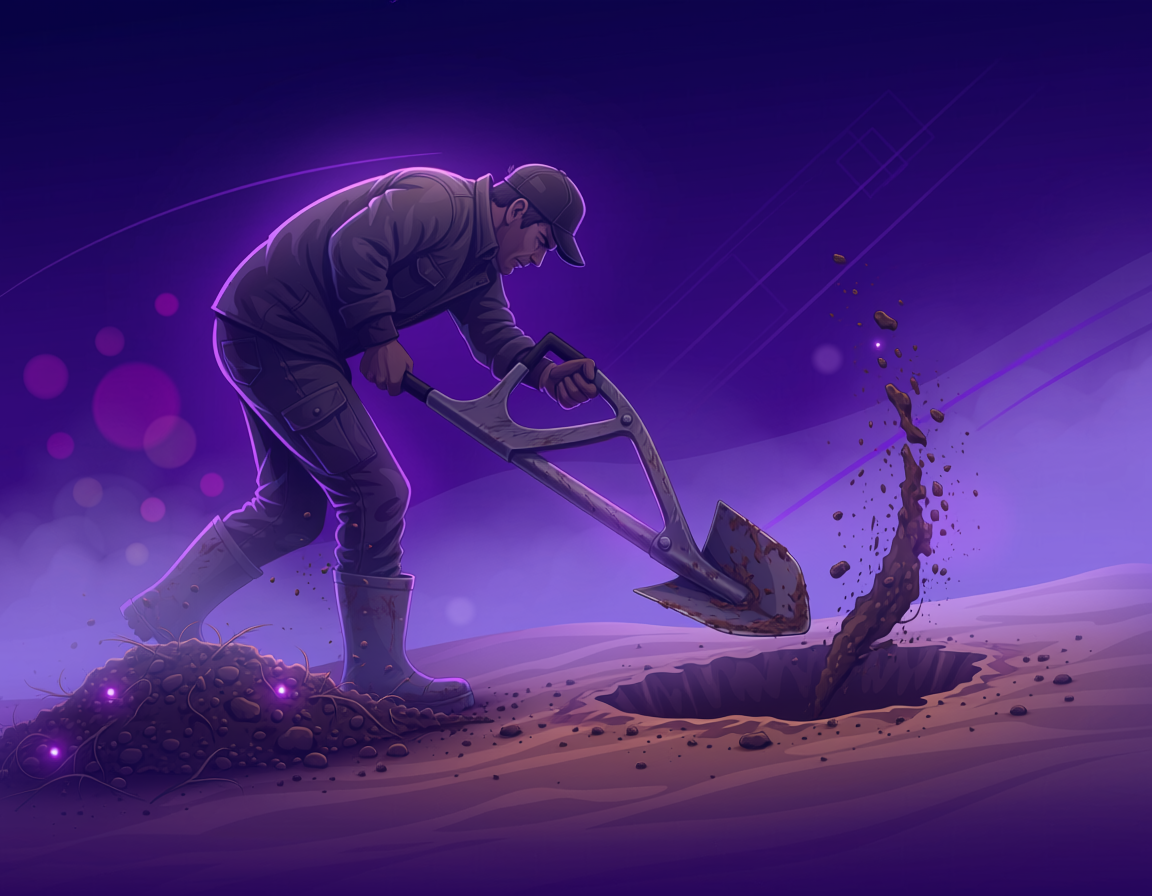
The Same Hole, Dug Faster
Lateral Thinking, an Unpaid Invoice, and What Is Still Worth Paying For
Issue 282, September 17, 2026
Sarah Tucker is the author of Edward de Bono: Love Laterally, a biography of the man who gave us the phrase lateral thinking, and this past weekend the Wall Street Journal ran a short piece of hers under the headline The Cost of Thinking for Free. She had been invited to speak to about thirty senior people in the financial sector who wanted to understand two things. What AI was going to do to their industry, and whether De Bono’s methods could help them find opportunity in it rather than, in her words, viewing AI solely as a highly efficient mechanism for making themselves redundant. What was meant to be a short talk became an hour and a half. The questions kept coming, about leadership, about institutions that cannot see their own blind spots, about younger people, about whether children will be able to tell what is real from what is made. A couple of people, she wrote, looked visibly relieved when she suggested the future might still need human beings.
Several days later she sent an invoice for a thousand pounds and learned there had been a misunderstanding. The session had not been considered paid work. It had been considered visibility, introductions, future opportunity. Exposure, in other words. Nobody was malicious. Nobody had discussed money beforehand, her included. And a room full of people whose profession is pricing things had left with a free education, while the person who gave it left with a lesson she summed up in five words. Value unspoken is value undefined.
There are two reasons to bring her piece into this newsletter, and this issue is about both. The first is the lesson itself, because it applies to far more than speakers and consultants. Anyone doing work that AI is changing, which is nearly everyone reading this, myself included, is going to have to say what they are worth in a way they have never had to before, and most of us aren’t ready. The second reason is De Bono. Lateral thinking is one of those phrases people use without knowing what it actually means or where it came from, and it turns out to be an unusually good way of describing what is going wrong in a great many AI programs right now and what change and transformation actually ask of us. So let’s spend some time with him and with lateral thinking. I think it is a great lens for looking at current times.
Digging in the Same Place
Edward de Bono was born in Malta in 1933, trained as a physician, went to Oxford as a Rhodes Scholar and on to Cambridge, and in 1967 published The Use of Lateral Thinking, which is where the phrase comes from. Six Thinking Hats followed in 1985 (that is the one most of us met in a training room, with a facilitator holding up colored cards). He wrote more than sixty books, advised governments and corporations, and died in 2021. For some balance, based on my research, his critics were never satisfied that his training programs produced lasting improvements in how people think. His reach, though, was enormous, and the central idea has held up better than the programs. Somewhat of a case where critics think one way and the public finds something that resonates.
The idea he put forward is simple and, once you see it, it’s hard to unsee. Most of what we call thinking is what de Bono called vertical thinking. You start from where you are, you apply logic, and you move step by step toward a better version of what you already have. It is how we solve most problems, and it works most of the time. But it has a built-in limit, which he put in one sentence. You cannot dig a hole in a different place by digging the same hole deeper.
Think about that for a few moments. I surely had to when I read it, because it describes an enormous amount of what passes for strategy. The hole is the current way of doing things. Digging deeper is getting better at it, faster at it, cheaper at it, more measured at it. Every improvement makes the hole deeper and more impressive. Lateral thinking, using that analogy, is the deliberate act of climbing out and asking whether this is the right place to be digging at all. De Bono was insistent that this isn’t a talent some people are born with. It is a set of moves anyone can learn and practice on purpose, and he spent his career naming them.
A few of the moves are worth knowing, as you will likely recognize them.
The first is challenge. Not criticism, just the question of why we do it this way, asked about something everyone has stopped questioning. This correlates to what I have represented in Transformation Theater and the recent Measurement Ratchet pieces. So yes, I am in the mindset of late on why we stop questioning, when we really should be asking more and more questions.
Most of the assumptions ingrained in organizational thinking and decision-making are never stated out loud. Everyone simply seems to know them and believe them, which is precisely why nobody challenges them. Tucker’s talk to the bankers was about exactly this: institutions trapped by assumptions they no longer recognize as assumptions. And then the bank proved her point. Everyone there assumed the talk was free, a bit of networking, and nobody stopped to question that assumption, so nobody noticed it was one.
The second is provocation, which De Bono marked with a word he invented: po. Po is a deliberately unreasonable statement put on the table without any obligation to defend it. Po: the office has no meetings. Po, the customer sets the price. You don’t argue with it. You use it for movement, to see where it takes your thinking before you judge it. This is the opposite of how most of us were trained, which was to evaluate an idea the instant it appears and kill the weak ones early in order to get to the best. De Bono’s point was that judgment applied too soon kills the idea that was one step away from a good one. His point should really cause us all some reflection, because we are so well trained and default so readily to our own human nature. In this regard, we are likely limiting our ability to get to the good ideas.
The third is reversal, which is simply looking at the situation from the other side, and the fourth is what he called random entry, bringing in something unrelated to force a new connection. Tucker used reversal and po on her own dilemma, along with a third tool she calls extreme, which pushes an assumption until its weakness shows, and found they made it easier to see how two intelligent groups could sit in the same room for ninety minutes and walk out with completely different accounts of what had happened. Which is, in a way, the whole point. Lateral thinking doesn’t treat perception as something to trust. It treats it as something you can move. And in a time when so much seems out of our control, perhaps the opening is in how we are all looking at it.
AI Is the Best Vertical Thinker Ever Built
Here is where de Bono becomes useful for today, and why Tucker’s bankers were right to want him, via Tucker, in the room.
What AI does, and does extraordinarily well, is dig the hole deeper. It works inside the frame it is given. It processes, drafts, summarizes, classifies, and predicts at a speed no person will ever match, and it does all of that without once asking whether the frame is the right one. That is vertical thinking, mechanized. And it is worth being honest that vertical thinking was the thing most of us were paid for. It is the layer of professional life we credentialed, promoted, and built careers on. The good analyst, the fast writer, the detail-oriented inspector, the thorough reviewer. That layer is getting cheaper by the quarter, and no amount of wishing will change it.
Now look at how most organizations are approaching AI, and you will see the same hole being dug faster. The AI strategy, if you read it closely, is nearly always an efficiency strategy.
Do what we already do, with fewer people, in less time. That is a perfectly vertical response to a lateral opportunity, and it is the response Tucker’s audience had come to hear an alternative to. It is also why so many AI programs feel to the people inside them like a countdown rather than an opening. If the only question being asked is how much of the current work the machine can absorb, then the honest answer is a great deal of it, and everyone in the building can do that math.
The lateral question is different, and almost nobody that I know of is asking it. Not what can the machine do that we used to do, but what could we do now that we could not do before?
Reverse it. If the machine handles the digging, what does the organization do with the people who are no longer digging, and does anyone have a plan for that beyond a smaller payroll? I recorded a conversation last week with David Edward for this season of the podcast that came to rest on exactly this: what to do with the capacity AI returns, and the striking thing about the question is how few leadership teams have an answer that is not a euphemism. The episode is available today wherever you get your podcasts.
This is also, for readers who have followed us for a while, the difference between change and transformation, put in De Bono’s terms. Change management is the discipline of digging the current hole better. It is valuable, it is necessary, and Kotter and Prosci and ADKAR have taught a generation of us how to do it. Transformation is a different hole. It begins with a lateral move, a challenge to the dominant idea of what the organization is for, and no amount of excellent change management will produce it, because change management is designed to make a chosen destination arrive smoothly, not to question the destination. We see this constantly. An organization announces a transformation, funds a transformation program, executes it well, and arrives two years later at a more efficient version of exactly what it was. The hole is deeper, and the hole hasn’t moved. Grant Van Ulbrich, an upcoming guest on the podcast, framed it to me in these terms. Change means an organization, and even a person, can return to the prior state. Transformation is like the caterpillar. It doesn’t stay a caterpillar; it becomes a butterfly, and it has become something else entirely. It is worth pondering whether everything we have been trained on in change management comes with the built-in option to simply revert. That is De Bono’s approach at work, seeing the same thing differently.
Why Intelligent People Keep Digging
De Bono had a name for why this happens, and it is uncomfortable. He called it the intelligence trap. In I Am Right, You Are Wrong he wrote that a highly intelligent person can take up a view and then defend it so ably, through choice of premises and perception, that the skill of defending crowds out any inclination to explore. The better you are at being right, the less you look around. Intelligence, in his account, is horsepower. Thinking is where you point the car, and a powerful engine pointed at the wrong destination just gets there faster.
I have watched this in more than forty organizations over the years, me included on more than one occasion, and it’s rarely a failure of ability. The people running the AI program are usually the smartest people in the building. They are extremely efficient at operating inside the existing system, which is how they got the job, and that efficiency is precisely what makes the dominant idea invisible to them. The publisher that knows it is a publisher. The association that knows members join for the journal. The bank that knows a speaker who talks about ideas is a networking event, and a vendor who delivers a service is a purchase order, and files a biographer under the first heading without anyone deciding to.
And here the measurement thread from the last two issues comes back in, from a new side. Everything an organization measures, it measures inside the hole. Licenses, hours saved, tickets closed, headcount reduced, adoption rates. Those are all measures of how well the digging is going. There is no number anywhere in the system for whether the hole is in the right place, and there is no line in the budget for the person who climbs out to look. So the lateral move, the one contribution that could actually change the outcome, is the one that is never counted, and what is not counted is not paid for. That is what happened to Tucker, and it’s what happens every week to the person in your organization who saw the problem coming and said so in a meeting and was thanked for their perspective.
What Is Still Worth Paying For
So what expertise remains marketable as the digging gets automated? The market has begun to answer, and the answer is consistent with everything above.
In 2023, researchers at Washington University in St. Louis looked at what happened on the freelance platform Upwork in the months after ChatGPT arrived. Writers, proofreaders and editors saw monthly jobs fall by about two percent and monthly earnings by a little over five. After the image generators arrived, designers and illustrators lost more. And the finding that should stop you is that the more highly rated freelancers were not protected. They lost the most, because the tools helped weaker performers most and narrowed the gap the stronger ones had been paid for. When the digging gets cheap, the premium for good digging goes with it. Upwork’s own workforce index this July found the other half of the sort. Freelancers using AI earn about a third more per hour than those who do not; earnings for complex judgment work rose forty-five percent in a year, and earnings per contract for simple generative production fell thirteen. Upwork sells the thing it measures, so treat those as a company’s view of its own marketplace, published for its own purposes. And relate this to last week’s issue, Small Waves, as you will likely be able to draw the connections on your own. Execution is being priced down. Judgment is being priced up. In many ways, a path forward.
Judgment, in De Bono’s terms, is the lateral move. It is knowing which hole. It is the challenge nobody else will voice, the reversal that shows the buyer what the situation looks like from the other side, the provocation that shakes a planning session loose from the answer it walked in with. And this kind of work has a peculiar and inconvenient property. It doesn’t look like work. It looks like a conversation. It looks like an hour and a half of questions after a talk that was supposed to be short. It looks like exposure, unless someone says otherwise, and the person who says otherwise first is the person who defines the value.
I will add our own recent experience with this value-defining challenge. Not long ago we lost a strategic planning bid for a small nonprofit, and as best we can tell, the reason was price. We could have cut the fee, and we chose not to, despite knowing we would really enjoy the work and the organization’s subject matter. What a plan from us buys isn’t the plan. Anyone can produce a handsome document, and the machines now produce handsome documents from a slew of notes, recordings, and more in an afternoon. What the fee buys is having been inside more than forty organizations and watched what actually happens after a plan is approved, which is the part almost no plan accounts for, and which is what makes the outcomes workable, realistic and achievable instead of admired and shelved. I can’t fully explain that in a proposal any more than Tucker could explain to the bankers what nine years of conversations with De Bono were worth. So we said the number that reflects it, and we lost, and losing on price is acceptable. Doing the thinking for free isn’t.
I share that story because the boundary took me years to learn, and I suspect most readers are still learning it. Tucker is honest that creative and intellectual people avoid the money conversation because it feels awkward, transactional, faintly vulgar. I can attest that it does, and it is something I still struggle with even after running a company for over twelve years.
We prefer the ideas, the immersion, and the work. So do I. And that preference is exactly what the market will exploit, not out of malice, but because ambiguity always resolves against the person with the least leverage, and in any room the person with the least leverage is nearly always the one who did the thinking. Ponder that one for a bit and I am sure you can align it to your own experience.
Climbing Out
De Bono’s whole career rested on one claim: that thinking is a skill and not a trait, and that the skill can be practiced on purpose. Tucker’s afternoon adds a corollary de Bono would probably have enjoyed. Knowing what your own thinking is worth is a skill too, and as AI takes over the digging, it is about to become one of the most important skills a working person can have.
So, two lateral moves to try this week, one for the organization and one for yourself.
For the organization, take the AI plan, whatever form it is in, and run a challenge on it. Why is every objective on this page a version of digging the current hole faster? Then run a reversal. If the machine handles the execution, what would we do with the capacity, and can we say it in a sentence a reasonable employee would understand and believe? If the honest answer is a smaller payroll, at least the plan is now telling the truth, and the people in the building already knew that. That outcome, however, isn’t helping your culture, building the capability of your people, or creating a shared purpose.
For yourself, run a provocation. Po, the thing I do that matters most is the thing that never appears on my job description. Don’t argue with it. See where it goes. What do you see, or decide, or change, that the machine working inside the frame doesn’t? Say it straight up to yourself first, and the next time a room asks for it, say it to them, and let the number follow.
Because value unspoken is value undefined. De Bono would have said the same thing about a hole nobody has looked at in years. The only person who can climb out and name it is you.
Related Reading
The Identity Renegotiation (Issue 276). What AI asks people to give up before it gives anything back. This issue is what happens when the renegotiation reaches the invoice.
Small Waves (Issue 281). Last week, on the millions of small decisions reshaping work without anyone announcing them. A declined invoice is one of those waves.
Who Owns That Number? (Issue 280). On measurement that accumulates and never gets removed. Here, the problem is the measure that never gets written down at all, whether the hole is in the right place.
Transformation Theater (Issue 275). When the change program performs transformation without producing it. Digging the same hole faster is the theater’s favorite act.
The Truth About Transformation. The book behind the method, on why most transformations fail and what changes when psychology comes first.
On The Human Factor Podcast
The Measurement Ratchet, Season 3 Episode 032. Why nothing you measure ever leaves, and why the measures we keep are all measures of the digging.
Research Sources
1. Tucker, Sarah (2026). The Cost of Thinking for Free. The Wall Street Journal, print edition, September 12, 2026. First published as Sarah Tucker: The Risk of Free Speaking, Finito World, May 22, 2026.
2. Tucker, Sarah (2024). Edward de Bono: Love Laterally. Aurora Metro Books, April 2024. Foreword by Baroness Helena Kennedy.
3. De Bono, Edward (1967). The Use of Lateral Thinking. Jonathan Cape. De Bono, Edward (1972). Po: A Device for Successful Thinking. Simon and Schuster. De Bono, Edward (1985). Six Thinking Hats. Little, Brown.
4. De Bono, Edward (1990). I Am Right, You Are Wrong: From This to the New Renaissance. Viking. Source of the intelligence trap passage.
5. De Bono, Edward. “You cannot dig a hole in a different place by digging the same hole deeper.” Quotation as published in the official Edward de Bono quotations collection, debono.com. Biographical dates confirmed against Thinkers50 and contemporaneous obituaries, June 2021. Descriptions of the challenge, provocation, random entry and movement tools drawn from the de Bono Group’s published lateral thinking curriculum.
6. Hui, Xiang, Reshef, Oren, and Zhou, Luofeng (2023). The Short-Term Effects of Generative Artificial Intelligence on Employment: Evidence from an Online Labor Market. Working paper, Washington University in St. Louis, Olin Business School, August 2023; later published in Organization Science.
7. Upwork Research Institute (2026). The Future Workforce Index 2026: AI, Freelancing, and the New Value of Work. Survey of 2,400 U.S. skilled knowledge workers, March to April 2026, with platform data. Published July 14, 2026.
Connect With Us
What leadership challenges are shaping your decisions right now? Share your experiences and join the conversation.
Go Deeper: Human Factor Podcast
From resistance and identity to the frameworks that help leaders navigate transformation. Available wherever you listen to or watch podcasts.

Kevin Novak
Kevin Novak is the Founder & CEO of 2040 Digital, a professor of digital strategy and organizational transformation, and author of The Truth About Transformation. He is the creator of the Human Factor Method™, a framework that integrates psychology, identity, and behavior into how organizations navigate change. Kevin publishes the long-running Ideas & Innovations newsletter, hosts the Human Factor Podcast, and advises executives, associations, and global organizations on strategy, transformation, and the human dynamics that determine success or failure.