
Everyone’s Work but Mine – Why We Are So Sure AI Is Coming for Someone Else’s Job
Everyone’s Work but Mine – Why We Are So Sure AI Is Coming for Someone Else’s Job
Everyone’s Work but Mine
Why We Are So Sure AI Is Coming for Someone Else’s Job
Issue 287, October 22, 2026
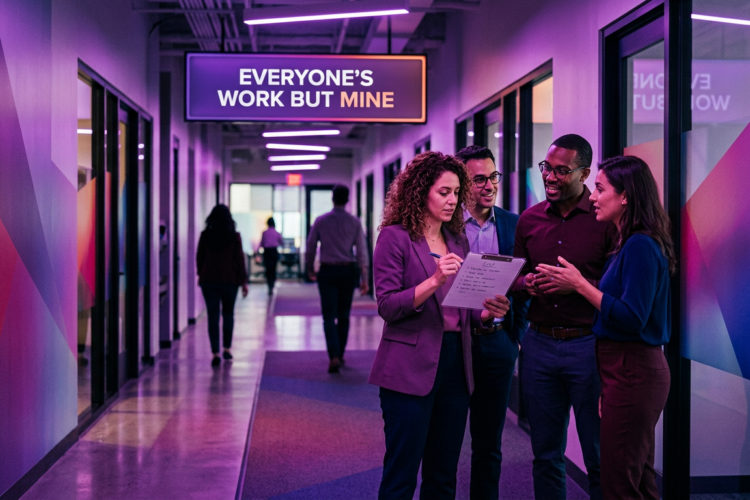
Most of us have lived through at least one downsizing or restructuring, and if you have, you remember the week or two before it happened. Everybody knew something was coming. The budget numbers had been adjusted, the leadership meetings were running long, and there were people in the conference room nobody recognized. In the hallway and over lunch, it was talked about openly as everyone tried to figure out what was coming and who it would affect. People drew conclusions and explored scenarios. But if you went around and asked each person whether their own job was on the list, most would have told you no, that they were safe because their role served a critical function. Maybe marketing. Maybe the team that just got reorganized. Not them, though, not their role, and not this year.
Then the list came out, and a good number of the people who were sure they were safe found their names on it.
A study out of Germany this fall describes almost exactly that hallway, only this time the subject is AI, which may be the best case study we have ever had of this happening in real time.
The University of Konstanz has been tracking AI at work since 2024. Florian Kunze, who studies organizational behavior there, leads the study, and in May of this year his team surveyed 1,105 working people. Forty percent of respondents expect AI and automation to have a negative effect on the labor market over the next ten years. Interestingly, only seventeen percent are worried about losing their own job. One of the researchers, Carolina Opitz, described it this way. People see AI as something society will have to deal with in the future, not as something that affects their own work today.
Those perceptions are interesting given the moment we are in, which I continue to call a very challenging and dynamic time. AI is not yet mature, humans are adjusting and trying to plot the future (which we are horrible at doing), and the media and AI companies continue to put forward doomsday scenarios that may be disconnected from how things actually unfold in the weeks and months ahead. What is happening, what is assumed to be happening and what the future might hold are cloudy at best.
Back to the research. Pew asked Americans much the same question in 2023. Sixty-two percent said AI would have a major impact on workers generally over the next twenty years. But only 28 percent said it would have a major impact on them personally, and about half said the impact on them would be minor or nothing at all.
So in two countries, three years apart, most people agree that AI is going to change work. They just don’t think it is going to change theirs.
We Have Always Done This
There is nothing new about this kind of thinking and where we land about ourselves. We do it about almost everything.
Back in 1980, a psychologist at Rutgers named Neil Weinstein asked a group of college students how likely they were to experience a long list of things in their lives compared with the other students on campus. Some were good, like owning their own home or liking their first job out of school. Some were bad, like having a drinking problem, a heart attack or getting fired. As a group, the students rated their own chances of the good things higher than their classmates’ and their own chances of the bad things lower. Not everyone can be better than average at avoiding trouble, but on the whole they believed they were. Weinstein called it unrealistic optimism, and researchers have found it over and over again since then, in different countries, at different ages and for many different kinds of risk.
A year later, a Swedish psychologist named Ola Svenson asked people how their driving compared with the others in his study. In his American group, 93 percent put themselves in the top half for driving skill, when by definition only half of them can be. We all know that driver, and if we are honest, most of us see ourselves the same way. The accident always happens to someone else, the person texting at the red light, the person driving too aggressively, anyone but us.
One detail in Weinstein’s work matters here. People were most optimistic about the risks they believed they had some control over, and about the ones they had never experienced themselves. Now think about your job. It has always been there. You are good at it, you show up for it every day, you have built the expertise to carry out your responsibilities, and nothing has happened to it yet. It checks both boxes, which is probably why it feels so safe.
It Isn’t Denial
It would be easy to say people are just in denial and leave it there, because for some that is the case. But a study published this summer suggests something else might be going on.
In July, George Ford, the chief economist at the Phoenix Center, a policy research group in Washington, went back through Pew’s survey data and asked what happens to that gap once people start using AI themselves. If using it makes people comfortable, the heavy users should feel even safer than everyone else. If the gap is just part of who we are, using AI shouldn’t make any difference. And if working with it up close makes the risk feel real, the heavy users should be the ones most concerned about their own jobs.
That last one is what he found. The people who use AI often turned their general concern into concern about their own work at a rate about ten percentage points higher than the people who use it occasionally, and that held even after he accounted for the demographic and economic differences between the two groups. In other words, the distance most people keep between “AI will change everyone’s work” and “AI will change mine” comes mostly from not having used it much, not from anything real about how exposed their job is. Ford said the heavy users are “the rest of the workforce, just a bit early.” That is likely because the heavy users are developing a better understanding of what the tools can do and where they are headed than those who have had limited exposure.
We know that some people really are less exposed than others. A nurse or an electrician has good reason to read the headlines differently than someone who spends the day writing reports for their organization. So not everyone who feels safe is wrong. For most people, though, the feeling isn’t based on anything they have actually experienced, at least not yet.
And that feeling is easy to hold onto when you look at what Konstanz found about people’s day-to-day work. Only 38 percent of the people surveyed use AI at work at all, up three points from the year before. Only 23 percent see it making any real difference in what their organization produces, and only 12 percent have noticed fewer entry-level jobs because of it. For most people, AI is still something they read about rather than something they see happening at the desk next to them. It’s hard to worry about something you haven’t seen or experienced in any significant way.
What “Not Me” Costs
The trouble, however, is that the belief has consequences long before anyone’s job is actually affected.
Start with readiness. Achilles Armenakis and his colleagues at Auburn University spent years studying what it takes for people to be ready for a change. They found it comes down to a handful of beliefs held at the same time. The change is needed. Leadership is behind it. It can work. And it actually matters to me, which they called personal valence. Someone can believe the first three completely and still be missing the fourth, and if a change belongs to somebody else, there is no reason to prepare for it. You can see this in almost any organization rolling out AI right now. The optional training gets polite attendance and very little follow-through. People nod along at the town hall, agree that the industry is changing, and go back to doing their work exactly the way they did it before. The pilot is happening in another department. That’s not resistance. People aren’t pushing back against something they think is coming for them, because they don’t think it is coming for them.
Then there is what is happening in the middle of the organization. When most experienced people picture the work AI will take over, they picture someone else’s work: the first drafts, the data pulls, the meeting notes, the spreadsheets the new hire used to update. It is the junior work, not theirs. And on that point they are partly right, because that work is going first, which I covered in this newsletter recently. But that junior work is also how the people coming up behind them learned to think, and the managers who used to hand it out and walk someone through it are exactly the layer organizations are now looking at hardest. The experienced professional who is sure AI is coming for the intern’s job, not hers, is missing what is actually disappearing. It is the work her own successor would have learned the job on. And nobody in the middle is watching it, because everyone in the middle believes it is somebody else’s problem.
The quieter the change, the easier “not me” is to be believed. A few weeks ago I wrote about small waves, the contracts that don’t get renewed and the jobs that never get posted. None of those show up in the hallway. There is no list. So the people who still have their jobs have nothing in front of them that says they might be next.
When It Finally Becomes Mine
Back in the hallway, the distance didn’t close a little at a time. It closed the morning the list came out, all at once, and it will be the same with AI. One day the tool shows up in your own workflow, or your role gets redesigned, or the work you took the most pride in suddenly takes a fraction of the time it used to.
William Bridges taught us that every transition starts with an ending, with letting go of something. A person who has spent a year believing a change belongs to someone else hasn’t let go of anything. They haven’t started their transition at all. So when it finally reaches them, they are not partway through it. They are at the very beginning, and they are starting from a place of having been caught off guard, which is about the hardest place there is to start from.
Last week I wrote about being on a different clock, how leadership finishes its own transition months before the workforce hears about a change, and how far apart those two groups end up. “Not me” pushes the workforce’s starting line back even further. The change may have been announced in the spring, but for the person who was sure it wasn’t about them, the clock doesn’t start until the day the notice lands in their inbox.
And when it does land, their reaction looks a lot like resistance. The questions come late, the frustration comes all at once, and the person who nodded through every town hall is suddenly upset about something that was “already covered.” That is where the misread comes in. Leadership saw a calm workforce for months and took the calm as acceptance. When the calm breaks, the easy explanation is that these people are resisting, when really they are just starting.
If Ford is right, this is going to happen to a lot more people as AI makes its way into more jobs, and it is going to happen to each of them on their own, at their own desk, on a different day from everyone else.
No List This Time
Think about that hallway one more time. Nobody in it was foolish. Each of them had real reasons to believe their job was safe. A strong review, a long history with the organization, an important client, a manager who valued them. Every one of those reasons was something they knew from the inside, while everyone else’s risk was something they could only see from the outside. That is how it works for all of us. Our own situation always looks more particular, more protected and more in our control than anyone else’s.
But the hallway at least had a list. One morning the names went up and everyone finally knew where they stood. AI won’t give us that morning. It will arrive one inbox, one workflow, one redesigned role at a time, and for a lot of us it will feel like someone else’s story right up until the day it isn’t.
So when you think about what AI is doing to work, whose job comes to mind first?
If it isn’t yours, look again.
Related Reading
The Disappearing Middle (Issue 284). On the early-career work AI is absorbing and the managers who used to turn it into judgment. Everyone in the middle assumes it is happening to someone else.
On a Different Clock (Issue 286). Last week, on why people start their transition when a change reaches them, not when it is announced.
The Misread (Issue 285). On structural friction read as individual resistance, which is what a late start tends to look like from the front of the room.
Small Waves (Issue 281). The changes too small and too quiet to show up in anyone’s count.
The Identity Renegotiation (Issue 276). What AI asks people to give up before it gives anything back. That renegotiation only begins once the change feels personal.
On The Human Factor Podcast
Measuring What Change Feels Like, Part 2, with Dr. Michelle Pipes. The second of two conversations, out this week.
Research Sources
1. Kunze, Florian, Opitz, Carolina, and Gerdiken, Elena (2026). Konstanzer KI-Studie 2026: Verlangsamtes Wachstum der KI-Nutzung am Arbeitsplatz, aber nicht für alle Beschäftigten gleichermaßen. Ergebnisreport Juli 2026, Universität Konstanz. Report and press release, September 8, 2026. Survey of 1,105 employed people in Germany, May 2026. Source for the 40 percent and 17 percent figures, the 35 to 38 percent usage figures, the 23 percent and 12 percent figures, and Carolina Opitz’s comment, paraphrased from the German.
2. Pew Research Center (2023). AI in Hiring and Evaluating Workers: What Americans Think. April 20, 2023. Source for the 62 percent and 28 percent figures.
3. Weinstein, Neil D. (1980). Unrealistic Optimism About Future Life Events. Journal of Personality and Social Psychology, volume 39, number 5, pages 806 to 820.
4. Svenson, Ola (1981). Are We All Less Risky and More Skillful Than Our Fellow Drivers? Acta Psychologica, volume 47, number 2, pages 143 to 148.
5. Ford, George S. (2026). Substance or Spectacle? AI Use and the Personal–Societal Risk Wedge. Phoenix Center Policy Bulletin No. 87, July 20, 2026. Press release and full bulletin. Analysis of Pew Research Center American Trends Panel data, Wave 119.
6. Armenakis, Achilles A., Harris, Stanley G., and Mossholder, Kevin W. (1993). Creating Readiness for Organizational Change. Human Relations, volume 46, number 6, pages 681 to 703. See also Holt, Daniel T., Armenakis, Achilles A., Feild, Hubert S., and Harris, Stanley G. (2007). Readiness for Organizational Change: The Systematic Development of a Scale. Journal of Applied Behavioral Science, volume 43, number 2, pages 232 to 255, the source of personal valence as one of four readiness beliefs.
7. Bridges, William, with Bridges, Susan (2016). Managing Transitions: Making the Most of Change, fourth edition. Da Capo Lifelong Books. First published 1991.
Connect With Us
What leadership challenges are shaping your decisions right now? Share your experiences and join the conversation.
Go Deeper: Human Factor Podcast
From resistance and identity to the frameworks that help leaders navigate transformation. Available wherever you listen to or watch podcasts.

Kevin Novak
Kevin Novak is the Founder & CEO of 2040 Digital, a professor of digital strategy and organizational transformation, and author of The Truth About Transformation. He is the creator of the Human Factor Method™, a framework that integrates psychology, identity, and behavior into how organizations navigate change. Kevin publishes the long-running Ideas & Innovations newsletter, hosts the Human Factor Podcast, and advises executives, associations, and global organizations on strategy, transformation, and the human dynamics that determine success or failure.